Showing posts with label gvi. Show all posts

Monday, August 26, 2013

All Your Base Are Belong To Us


It’s not always easy finding people to travel with – and my own major issue is that I don’t really have friends or family who are interested in travelling to the places that call out to me. It doesn’t help that I tend to make decisions on a whim, or that I’ve been told in the past I’m a bitch who isn’t worth travelling with.

Probably understandable, in that this is the major reason I wanted to go to NYC.
But yes, I make odd and sudden decisions when it comes to destinations – in fact one of my favourite trips ever was an impulse trip to Mexico, and I ended up there only because I couldn’t stop listening to ClintMansell’s incredible soundtrack to Darren Aronofsky’s The Fountain, and I was also playing Tomb Raider: Underworld and was enchanted by the Southern Mexico level. So, I ended up on a Gecko’s tour from Mexico City to CancĂșn. Now, Gecko’s has a policy that they won’t charge a single supplement on the assumption that if there is another single traveller of the same gender on your tour, you will share a room. After we had to share a giant bed in Mexico City – and this after our first meeting involved watching the riot police line up right outside our window – my roommate Nicole and I got along just famously. Truthfully, I have been on three Gecko’s tours and found the people each time to be wonderful. In particular, our tiny Turkish group made many a happy memory together. 

We also made our tour leader wear a fez. I still doubt he's ever forgiven us.
 I still felt some trepidation about South Africa. I knew that I would be sharing small spaces with a large group of people, and I’m…a loner, by nature. Or by necessity, perhaps (see the “bitch” comment above). I also live alone, so it’s pretty peculiar to go from having an entire flat to yourself to sharing a room with…well, more people than I actually ever counted. I believe it was probably twenty people, in the big dorm? But then, maybe it says something, that I never counted. Because I didn’t need to.

When you first sign up with this trip, you don’t know if you will be in KwaZulu-Natal or Limpopo until about six weeks before you go. I was lucky enough to be sent up north, which is where I wanted to go, though I wasn’t quite sure why (in theory I should have preferred KZN, as my father was concerned about me travelling in South Africa alone and all his contacts are in the Richards Bay area). Excited as I was to be going up there, as I collected my kit I did begin to worry about how I’d survive.

Not my bed in Limpopo.
We arrived in the dark. We knew this; it was made clear before arrival that the base only had generator power and that for only a few hours at a time. The gennie was off when we arrived on our long and dusty drive from Jo’burg, and Andreas thoughtfully warned us to watch out for Zuri – being black as night and friendly as heck, we were likely to experience said friendliness long before we saw it coming. And thus, we stumbled into the welcoming embrace of the staff and current vols, with a few good licks from the base dog to accompany it.

Honestly, in the dark, she's like the bloody Predator. Only with less screaming.
We claimed our bunks by light of many a headlamp – as it turns out, bottom is best, though I ended up on top. Being the middle of winter, the mosquito nets weren’t really necessary, but given Kathmandu had recalled my net just before I left and I went to considerable trouble to get another impregnated one (from Lifestream, who are well worth supporting), I totally put mine up. Actually, everyone did – because while we maybe didn’t need them because of the wildlife, they still gave a little space of one’s own. …kind of like a curtained four poster bed. Only without the silk and delusions of kingly grandeur, I guess.

(Which isn’t to say the reserve itself doesn’t have its luxury accommodation, we just never saw it. The closest I ever got, actually, was sitting in the truck in a driveway…which was a hilarious story in and of itself. After spending a futile hour attempting to change a tyre in the close vicinity of two lionesses and two lions, we were “rescued” by the giant jack brought over from the nearby lodge…who then refused to let us tighten the wheel nuts anywhere near the lions. Frankly, by that point, we were blasĂ© as hell as we figured they’d have eaten us long ago if they actually cared enough to bother. But our rescuers insisted we follow them to the lodge before we actually finished the job properly. And yet no-one was invited in for a stiff drink! I can only but hope they were serious about the whip-round to get the base a few decent jacks, however…)

LION DON'T CARE.
 I never slept particularly well on base, but that’s just me – I don’t sleep well at the best of times, and certainly on the first night we were treated to a lullabye courtesy of the local hyena clan. Though I had had considerable drama getting to South Africa thanks to the absolutely rubbish service provided by Jetstar, and had been unable to get the planned Good Night’s Sleep in Johannesburg, I was more interested in lying awake and listening to the hyena about their evening.

Still beats "sleeping" in Perth Airport when you swore to god you'd never go back again. THANKS, JETSTAR.
But we were up at five or six the next day – I don’t actually remember, being that we would normally be up at five most mornings, although I suspect they let us have a “lie-in” that first morning. But this was how life worked on base: up early to go on first drive, which had a winter start of six. We’d be back by maybe ten-thirty or eleven; second drive would leave at three for a return around seven or so. The afternoon space was usually filled with lectures or perhaps a trip off-base – most memorably to the animal orphanage and bush school at Daktari, though we also visited a local school and it was one of those things you never forget – and the evenings usually involved dinner, a bit of mucking about, and then an early night. This was the ebb and flow of my life in those two weeks, and it was a tide I willingly gave myself over to. 


It’s very different to life at home – but in a way I think that total difference is what makes it easier to adapt to. We were told up front that we weren’t there to have a holiday, and though I suspect this wasn’t what some people had signed on for, everyone on base had a common passion: the animals. Some of us were more passionate than others; I know I felt keenly my ignorance in the face of these brilliant people. In fact I felt a bit of a fake, though I did respond to it by reading some of the many books about the teaching room, and by asking many, many questions – I’m in fact surprised no-one sent me outside to sit and think about what an annoying twat I must have been. Although then again I would go and make a fool of myself quite regularly by running about with Zuri anyway. It must have looked ridiculous: the sleek black dog with the build of a cheetah being chased about the lawns by a tubby little human with no coordination or grace whatsoever. …hell, no wonder I used to hear the hyena laughing.

Or maybe that was just Zuri. I swear she ate so much bone she must have been part hyena herself.
 Still, it was that passion for the work on the base that tied us together. We had this in common, and though we had a large group of people in a small space, everything just worked. I put a lot of this down to good base management, though: the staff had it all worked out, from one job to the next.
And I can imagine it would have been a disaster if they didn’t. The base was not fenced in any way – we were one big building with several small satellites, a driveway, and areas of mown grass. Once you got to the long grass, though, you were back into reserve territory…which was no joke, considering the proximity of the hyena den, and the fact that at least two large male leopards had their territories in the immediate vicinity. Basically, if you wanted to be alone? You hadn’t much choice. Some of us decided that the knobthorn tree in the driveway could be the Fortress of Solitude and if someone was seen to be sitting under it, best leave them to it, but surprisingly enough it didn’t seem to be that necessary. Because there was always something to do.

It’s funny, too, how the simple things can sometimes seem big, but then…they don’t have to be. As I said, there were about thirty of us around, including staff, and at least twenty of us were sharing the same two toilets and two showers – not to mention that despite rumours to the contrary there was hot water, but it was limited. As in, you could get hot water in both showers and in the laundry sink, but never simultaneously. And of the two toilets, one could cope with liquid and not much else. Recipe for disaster, you say? …no. Not at all. In fact, living like that does a person good, I think. I’m one of those assholes who is wound really tight, though it’s not always obvious; I remember once being told in Doncaster that I generally was known to be “so laid back as to be horizontal!” and I have no idea how I got that rep, considering I am usually hell to work with.

Still, I found on base I just…let stuff go. I’m not sure what it was. I remember being really freaked out about the idea of base duty, because in our second week the new vols were put on the roster; I was on with Elena, which I had no issue with because she was always good value and we got on. I was concerned, though, because base duty involved not only cleaning – which I can live with – but also cooking. I am a lousy cook. I mean, a couple years ago I went off my nut and baked almost constantly (my workmates were ready to smother me, I think; I tend to bake very sugar-rich things and though I couldn’t eat them, they sure did), but I can’t cook to save my life. I also generally dislike cooking for other people, because I tend to screw it up and then feel embarrassed for the next three days because people had to suffer through my food instead of having someone good cook them decent food.


I have developed kind of an obsession with Tennis biscuits, though.
 Still, the recipes were purported to be idiot proof (cold comfort to a career idiot like me). Even then I might have got over it, until I realised – we had to make bread. I was terrified. I mean, I know how to make bread; I’m known to do it for fun. But making little bread rolls for thirty people who I’m sure already realised I was a bit of a special one? Oh, lord.

With that said, Elena had never made bread, but was a very good cook – so I guided her through lunch, she guided me through dinner, and things worked out just fine. Which, really, was what life on base really boiled down to. We were different people gathered together for the same reason, and that link kept us together. And besides, I didn’t mention the best thing about base duty. 

I was washing the showermats in the big stone sinks on the veranda when I noticed Zuri sitting by the door. “What’s up, girl?” I asked, wandering over as I dried my hands on my trousers. Her tail thumped on the floor – once, twice. Her ears twitched to match, acknowledging my nearing presence. But she didn’t look away. When I took my place next to her on the step, I saw it: in the garden, a herd of impala meandered through the long grass. 


I was told they are the McDonald’s of South Africa, ostensibly because of the distinctive black “m” on their rumps, but more likely because everyone likes to eat them. They’re also pretty (understandably) skittish, and a right bastard to count on Impala Week. Yet that morning, this herd of maybe twenty or thirty individuals grazed peacefully in the garden while Zuri and I sat in the doorway, watching them. I had work to do – Zuri didn’t, unless she gets paid for something I don’t know about – but I could take a break just to watch. It was a gift, and one I felt I didn’t deserve. …which naturally didn’t stop me from grabbing it with both hands. 

Of course, I later stuck my head into the office, spotted Jamie, and said: “If I tell you there are impala in the back yard, are you going to tell me to count them?” and got the reply of: “Unless you’re standing on the driveway, it doesn’t count!” so all was well. Because otherwise I was totally playing the “dumb vol is dumb” card and claiming they were kudu or something.

IF I SAY THEY KILLED SIMBA'S DAD I DON'T HAVE TO COUNT THEM, RIGHT?
 Life on base was pretty chill, all things considered. There was always something to do – and even in the calm moments, it could change in a second, such as the evening of Pangolin Pandemonium (best not mentioned to You Know Who), or my last night when we came careening in on the truck to a) shut Zuri in and b) pick up our base manager because two male leopards were posturing all about the base area. I just find it incredible that a person like me, so very used to her solitude (and often very deserving of being left to her own devices), was so easily accepted into the life of this place. There’s just a feeling of acceptance that seems very suited to the area – because we humans, we’re just guests on the reserve. We say we gave it to the animals, but we live there by their grace and generosity. And you don’t forget it, not when you look up from reading Nelson Mandela’s Long Walk To Freedom to see a giraffe gracefully stretching its neck across the volleyball court.


Our base manager asked us on our first full day to remember that while we were just passing through on a working holiday, that for many of the staff, the base? Is their home. And within a few short days I knew what a privilege it was – for them to live there, and for us to be allowed to share in it. And even when I couldn’t sleep for hyena and snoring and sleep Tourette’s (…don’t ask), I wouldn’t have changed it for anything.

Although you have to see the funny side of it, that the best night’s sleep I had was when we camped out near the hyena den in a dry riverbed. Even with the braai encouraging the hyena to come investigate their new meat friends and having to be woken for an hour’s watch, I slept like a baby. Note: shouting “MUFASA!” at hyenas makes them run. It makes them run good.

Ask us how we know.

That’s just the kind of people this place attracts.

Also: KEROSENE.

Thursday, August 22, 2013

And I Am Dreaming of Them on the Plains


Everyone has favourite animals – though it wasn’t until I was at the zoo in Perth back in 2011 that I realised that my mother is fond of elephants. It’s a bit shameful, given I was somewhere around thirty years old at the time, though I’ve never been particularly observant (and I’m sure there are more than a few people in this world who will gladly tell you I am a self-absorbed little shit). 

We probably have a few things in common, this fuzzy little dude and me.
 Still, I always knew at least one of my aunts had a thing for elephants; she has some lovely wall hangings I remember well from childhood, bought during the time she and her family lived in Rhodesia. And I do remember my mother telling me once she read a lot of Wilbur Smith’s African-based novels after my aunt moved to Africa, in order to get closer to that world and experience. This came about, ironically enough, when I bitched to her about an Egyptian novel by the same author; I became so disgusted with it I actually abandoned the damned thing in a hotel in Mexico somewhere – probably MĂ©rida, come to think of it. Man, I loved that hotel room; it was like a cross between a sauna and a batcave and my roommate woke up more than once screaming that she didn’t know where she was.

Still, I got to thinking about elephants because I recently read Lawrence Anthony’s The Elephant Whisperer, and it evoked a lot of memories of my two weeks in South Africa. Admittedly I spent my time in a different part of the country; I was up in Limpopo, and Anthony owned Thula Thula down in KwaZulu-Natal. I thought of my mother while reading the book, however, and suggested she ask my father to take her there. Apparently his time in Richards Bay hasn’t invoked any great desire to return to the area, however, so I may end up being the one to do it. Which I won’t complain about, being such a dutiful daughter and all (OMG MORE ANIMALS).

Elephants have never been really high on my list of favourite animals, mind you. It’s not that I have anything against them, but I’ve known since roughly the age of eight that my ultimate destiny is to become a crazy cat lady. To that end, it’s probably unsurprising that the animals usually topping my lists are tigers and cheetahs. (Generally cheetahs win out, because while I can’t resist a tiger face and paws, truth is any decent tiger wouldn’t be able to resist the meat meal I offer, fat-riddled or not. Still, who could resist that face?)

Or those fingers.
I spent two weeks in South Africa with GVI on a private game reserve as a volunteer – my poor excuse for “help” mostly involved aiding in data collection and collation. And I say “poor” in the sense that no matter how well I am trained to do anything, I am a derp and therefore probably create more problems than I solve. Most of the data collection at the reserve revolved around the carnivores: the leopards, lions, and cheetahs. And I’m a cat person, as I said, so this was fine by me.

But as we careened about the reserve looking for kitties, we often heard the game drives calling in the location of the “ndlopfu,” the breeding herd of elephants, around the upper rivers. (Note: I am uncertain of the spelling; I was told the language for the animals over the radio was Shangaan, and that’s the spelling I get from ye olde Google, though I obviously do not understand the rules of pronunciation at all!) Being that we were generally based at the other end of the reserve we wouldn’t generally run into them by accident, so the day we finished up fairly early on a morning drive and Kaggie said: “They called in the elephants by an acacia grove nearby, who wants to see elephants?” we were naturally pretty down with that.

We were the only research truck out that morning, mostly populated with the infamous two-weekers – those of us who, for whatever reason, could only come to the reserve for a period of two weeks. The others were staying for periods ranging from four weeks to as much as six months. And believe you me, while I was concerned I might not cope with two weeks I was utterly miserable about leaving when I did; I would firmly tell anyone else wanting the full experience to do the four weeks at a bare minimum. And then beg to be allowed to stay longer. I suspect offering to bake a lot might be a worthy act of bribery.

Still, we two-weekers were the major suspects on this trip because the other new recruits were obliged to stay back at base and do a first aid course. I contemplated doing it myself, just because I still haven’t updated the one I’m required to hold as a health professional, but in the end the call of the wild won out. Not even the assertion that this course would involve: “…bush first aid, like snake bites, or what to do if an elephant flips a truck!” could keep me back. I’m not Australian, after all.

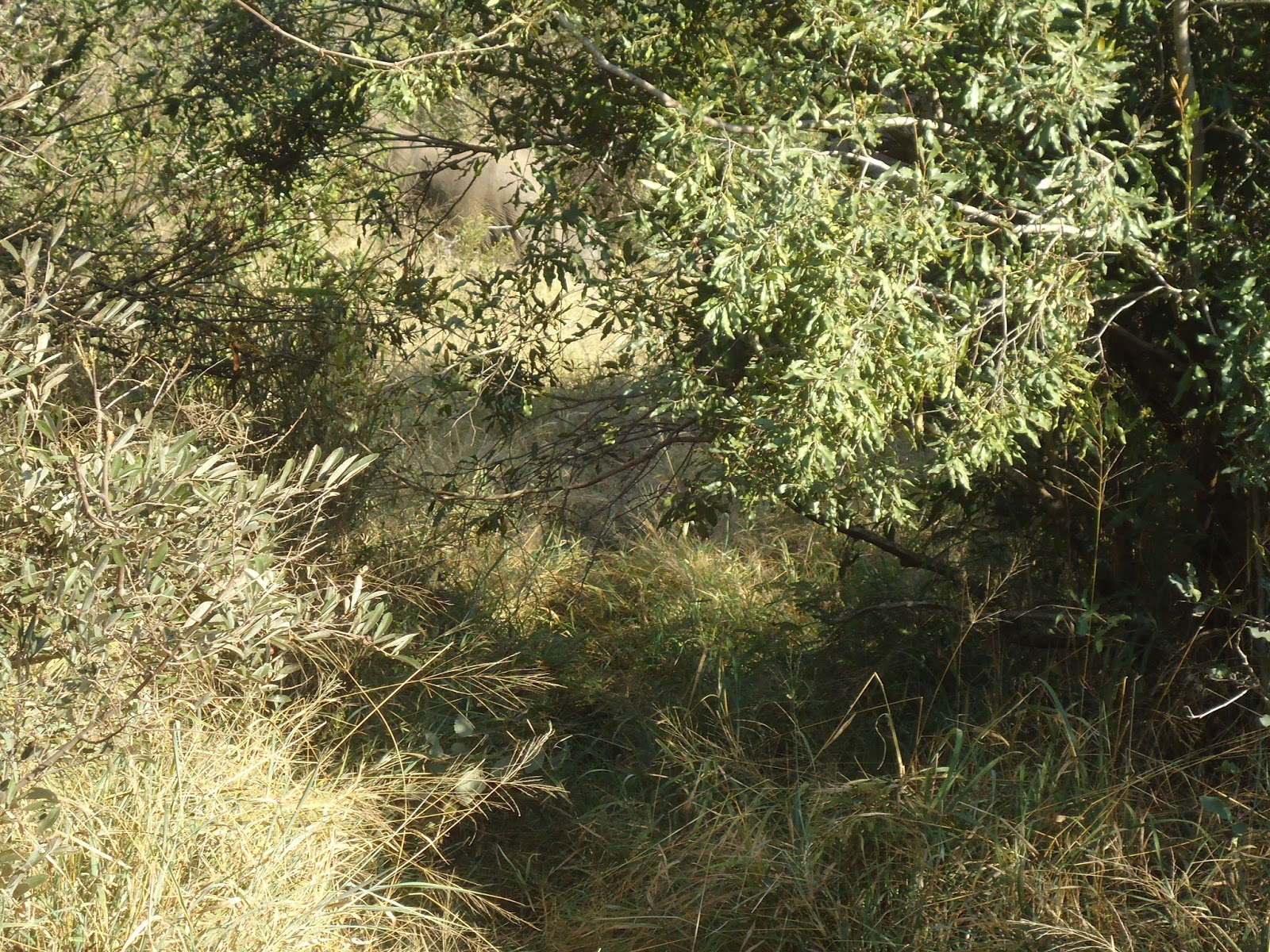
I am, however, a lousy photographer, and therefore I only had with me a little point and shoot thing that slipped into a trouser pocket easily enough (or perhaps not easily enough, given the sheer number of times I missed said pocket and then would panic and have to ask the poor driver to stop the truck so I could make sure I hadn’t left it half a kilometre back or something; it’s not so stupid, seeing as one day I did manage to leave my ridiculous Peruvian alpaca-knit hat in a low-hanging tree). This camera of mine has a terrible zoom, though I did swipe some very nice binoculars from my father. Our first sighting of the elephants, you see, came at a distance.

WHERE'S WALLY?
 It might seem almost disappointing at first, but I sure didn't think so. Actually, I think the most incredible thing about being on this reserve was having nothing between you and the animals. My first drive involved sitting perhaps twenty feet from a full-grown male lion feeding on a wildebeest, and believe me, I will never forget the sound of ripping sinew and crunching bone. He also obliged us greatly by calling to the two females of his pride; talk about great African soundtracks. 

The old man soon went back to Business As Usual, mind you.
 So, even though we were just glimpsing great shapes moving in the distance between the criss-cross of leaf and tree-trunk, it was pretty damned amazing. It’s kind of like whale-watching, in a way: you stand on the edge of a world that is not your own, and you watch as if through an ever-shifting veil the movement of those who are masters of that place. That is, in itself, an experience of awe.

Kaggie, however, decided we would go on a bit and follow their trail to see if we couldn’t get a better look at them. And while elephants can be surprisingly quiet and stealthy, they are what you call a keystone species – they change their environment quite drastically as they go about their lives, and therefore it’s…kind of obvious where the herd has been. So, we drove along their bushwhacked path until we heard the unmistakable snap and crash of elephants feeding. Kaggie then killed the engine and there we sat, all craning over one another to get what was, for most of us, our first good look at African elephants.


 I believe I’ve only ever seen Asian elephants, before. Certainly I’ve only ever seen them in zoos, and I always tend to remember them as having rather small ears, so I suspect this must be true. So, to see full grown African elephants browsing so close, and so clear? To have no boundaries, no barriers, except the respect of one animal for another and your basic common sense? Absolutely incredible.

As the breeding herd moved off, I sat back in my seat between two other vols on the front of the truck, feeling quite overwhelmed. Lions and cheetahs, it seemed, were one thing; elephants are something else entirely. The cats seemed quite content to ignore us, by and large; I had a far greater sense of awareness, from the elephants. Which isn’t to say they seemed actively interested in us, but they did seem to spare us more thought than the cats did. Then I figured it was probably just my imagination.

Pretty sweet imagination, though.
Which was when Mister M showed up.

But you, you may call me Sir.
 He came meandering in from the left – and the nonchalant confidence of these great animals is what amazes me the most. Oh, I saw youngsters scrambling along the road after their elders, quite intent on running past the many-headed creature that belched smoke and noise, but the adults knew damn well that they were the ones letting us alone, and not the other way around. Though Mister M, it seems, had decided that today was the day for introductions. 


On a later drive I was told Mister M has a habit of trailing along after the breeding herd, a bit of a loner – because the matriarchal structure of elephant herds means that once they’re past adolescence, the boys tend to get kicked to the curb. They then form their own bachelor herds, hopefully under the guidance of a wise old bull, and then just wait for the ladies to take notice of their big tusks and manly stride and fifth legs, I guess. Mister M apparently likes to wander after the girls, and he did his wandering that day right in front of our truck.

He then decided to turn about and make friends.

Oh, I can count your wrinkles! ...um, did I say wrinkles? Er, I meant...personality lines!
 I think it is impossible to convey in words the sheer size of a full-grown African bull elephant. I do not have any pictures of what came next, as shortly after this picture was taken Kaggie called back: “SIT STILL AND DON’T TAKE ANY MORE PICTURES.” Because Mister M stood right beside the truck, facing the six vols, taking us in as we stared back with wide eyes and trembling hands. Although even then, we didn’t really stare; I know that I kept my eyes away from his, for most of the duration of this curious little meeting. Because the two or three times I dared to glance up, I found he stared straight into my soul. And I do mean that. His gaze could only be called searching, and he matched it with the progress of his trunk. In fact, I could see right down said trunk as he moved it all about us in overt investigation – and if ever I want a reference for Lovecraftian tentacles, I think I got it that day.

I was also told another day that it’s amusing as heck, to watch a very young elephant try to utilise its trunk. It is an exquisite piece of biomechanical engineering, immensely strong, and capable of surprisingly delicate work. Apparently it takes a bit to master, considering baby elephants flail it about like a wet noodle. Seeing Mister M’s up close was therefore an amazing experience, though somewhat sobering after you’ve seen other elephants snap branches thicker than your arm like toothpicks with those same appendages.

Thanks, Flippy, for the visual. I'll just go cry in a corner for a while now, 'kay?
 We sat in absolute silence as Mister M investigated us -- though not strict stillness. Marion, who sat between me and said elephant, in fact executed a subtle and graceful lean until she was perhaps at a forty-five degree angle, while I went for some thirty degrees myself. She had the dignity to apologise afterwards, to which I could only say: “Er, I wasn’t exactly going to say GET OUT OF MY LAP before shoving you back into an elephant’s face!” Such is the camaraderie of those who live and work closely together in the great outdoors.

But after Mister M took his leave, we sat in stunned silence for a long moment. And then it escaped: our outburst of relieved, half-hysterical laughter surprised a few birds from the trees. “I thought we were going to have to call base!” someone said. “Yeah, ask how to the elephant-truck-flipping-scenario work was going…because dammit it’s time for the practical exam!”

Yet I didn’t feel any malice from Mister M. Sure, I felt the urge to dip my head and call him Mister M Sir, but I think more than anything else, it was about realising how very small we are. And not even in a physical sense, for all he could have squished me flat with one well-aimed tread of his foot.

As people, we humans tend to think we have the jump on all other animals when it comes to intelligence and communication. Yet I felt Mister M was talking to us, and it wasn’t his fault we couldn’t understand, couldn’t answer. It felt like he spoke to us in the simplest of all languages, and yet my mind overcomplicated things so much I had no chance in hell of replying to him in turn. In a lot of ways, that was the only time I was genuinely afraid of anything on the reserve, and not because I thought he would hurt us. It was more that I was afraid of realising how very ignorant we can be, building our little empires on the pyres of theirs and forgetting that the world belongs to them as much as it does to us.


 I saw the elephants several more times, before I left. We even had a lovely experience where our battery died amongst the herd and we had to radio for assistance; there was much hilarity when the cavalry almost arrived only to find the elephants blocking the road, necessitating an alternative go-round route and the theory that perhaps they knew we were stalled and therefore easy pickings (!). But in that forty-five minutes of waiting, I sat my chin on my palm and watched Mister M, far from the herd over the river, going about his day, and felt quite content.

Although we're kind of playing Where's Wally here again, aren't we.
 Life, for many of us, seems to be about control. I wonder if that is why humans have come to be where we are: this need to master our surroundings, to defeat enemies we conjure up out of our own wild imaginings. We fancy ourselves the superior species because we are the ones who allow others to survive by dint of our generousness, by sharing dwindling resources and space. And it’s ironic, really, when you realise these animals live with a grace that we can only imagine. We are at war with our world. They simply exist within it, day by day. They do not feel any need to look at the chaos of the natural world and rail against it. Instead, they fit themselves amongst its weave, move with every stretch and tear – and so their story goes on, woven upon a loom I sometimes think remains ever invisible to us.

Maybe I’m just being too poetic. Maybe it’s just sentiment, or foolishness. But I watched those elephants from the truck on those African winter days, so far from my own home (though still under the same southern skies), and realised how very far we’ve strayed from the world we often imagine to be long gone. It’s not, you know. I think we’ve just forgotten how to live there.

There are those that always remember, though. And we need to work to ensure that they will always be there to do so: for themselves, and for us too.

...I think I took the thematic thing too seriously in high school English, I'm sorry.

A Meandering

My father was a scout master, so it would seem only fitting that my travels would follow along the lines of “be prepared” – besides, I’m known to be somewhat paranoid at the best of times. When travelling with flatmates in Europe one late summer, they were surprised to discover I had on me the phone numbers of embassies and consulates in various countries for no apparent reason other than “just in case.” My only response to their laughter went something like: “Don’t you dare ask me for the number when you can’t get it anywhere else.”

Yet despite always having that option of calling home, in a lot of my travels? I have tended to let go of a lot of rational thought once I hit the ground. I think it’s a good way to be – because though you will always go into a new situation with some expectations, the less solidity you allow them to have, the more childlike your wonder can be.

I recently spent two weeks derping around a private game reserve in Limpopo, South Africa – and I say “derping” in that I was technically a volunteer, though I believe I was more underfoot than overly useful. Yet to my mind, the experience changed a lot of things in my dodgy excuse for a brain. I decided to go on something of a whim in January, though I had long intended to go to Africa as something closer to an eco-tourist than just a sightseer. Things were likely shuffled along by my father recently spending a six month stint working in Richards Bay and tormenting me with pictures of his days off at various reserves in the KZN area, but my heart was singing for something new and I figured I now had the chance and motivation to learn the words for myself.

I prepared for the trip only in a practical sense, gathering my kit and collecting various phone numbers and advisories (although I must say the only real trouble I ever had stemmed from Jetstar being the endlessly unreliable aviation service they will likely always be; they considered it a fair deal to strand a lone female traveller in Johannesburg instead of making the slightest effort to put me on the plane still waiting on the tarmac despite their delayed service, for example). But I didn’t think too hard about the animals. I had chosen this trip specifically for the animals, but I just didn’t think too hard about them. I wanted no expectations. I just wanted to feel something, again.

There was always one little niggling expectation there, though – because we all have our favourite animals, don’t we? A friend I knew well in high school told me once that I was “independent as a cat,” and I guess she had a point. I am a cat person, probably because I can be precisely as snotty as one. And for reasons I have never understood, I have always loved cheetahs. When I arrived at Karongwe, I was therefore looking very much forward to seeing them, in person and in the wild, for the first time.

My first experience with the cheetahs turned somewhat fraught, however. Up until that particular day, for whatever reason the trucks I had been on had primarily dealt with the lions, and likely also a fruitless hunt or two for the infamous Tsavo, a leopard who might as well be a ninja for all the substantial glimpses I caught of that big boy.
But when the day finally came when I travelled on a truck that also carried a rifle – a mandatory accessory for a cheetah walk-in – there were two small problems. Firstly, I was doing proper field telemetry for the very first time. Secondly, we had Tom onboard – Tom being a very quickminded and clever photographer who also had to ship out again at twelve. So, we had no time for dilly-dallying, as they say.

Let’s just watch me dilly-dally.

One very humiliating bout of mobile tracking later, I wanted to just sit down in the long grass and bury my head in my hands, possibly with a t-lem antenna poking me in the eye as punishment for being a particularly poor excuse for a data-collecting volunteer. And yet I kept trudging along in my little boots, face grimly set and a box pressed to my ear, ever taunted by the beeps of an implant that was there but not. And then, finally: the cry goes up.

“Found them!”

Two cheetah males, lying in the early morning sun, full bellies lightly dappled curves under an African sky. It wasn’t silent, of course – we were too excited for that. It was more of a back and forth, a pendulum swing between murmurs, rising wonder; and then comes the quiet, the awe of knowing that we stood but feet away from creatures so utterly unlike ourselves, and yet they shared this space with us despite all we’ve done to take it from them.

I could have watched them for hours. I would have been quite content just to hunker down on my knees, to forget the horror of finding them, and just…be there. Silent and watchful, yet another passing shadow in the tenebrous lives of these cats. But I would be a shadow that lingers, perhaps: not quite ready to leave the warmth of that brightness they gave to me that cool winter morning.

fig. i: INSERT IMPALA HERE

I saw Jabu and Djuma again in my time there, of course. In fact I will be endlessly grateful to Andreas, because on the last proper drive of the two-weekers of June 2013 he indulged my falteringly-voiced hope that we could perhaps see all the cheetahs, and allowed us to find both the boys and also the mighty Ketswiri – and both sightings were extraordinary and also ironic, considering we needed the rifle for neither. In fact we almost drove straight past the boys, sunning themselves in the company of jackals right on the side of the road by a boundary fence (and some industrious workers, no less). Ketswiri, on the other hand, had very recently taken an impala and had the battlescars to prove it: with one eye held closed as she breathed hard, the bloody carcass to one side as she kept her good eye on those who came to see her about her work.

I am thinking of Jabu and Djuma tonight because while flicking back through updates on the GVI page, I had the terrible realisation that I had missed something from last month: Jabu has died, leaving Djuma to go on without his brother. And it is peculiar, of course, to think of how hard that knowledge hits. From my very first drive I saw how life works in the wilds of southern Africa – for some time I watched a male lion gnaw his way through a waterbuck. My tummy even rumbled in carnivorous sympathy, apparently recalling the earlier assertion that many of our own meals would be vegetarian. I understood that this is, as the mighty (and coincidentally placed-at-the-top-of-the-food-chain) Musfasa would put it, the great circle of life.

(Although we likely weren’t so philosophical about it in our lower little monkey-brains half an hour later when we were pushing a vehicle to jumpstart a dead battery some fifty metres from said lion, but then again he'd already had dinner; why go out for hamburger when you’ve got steak at home? Besides, I’m the other white meat, and well-insulated to boot; he’s better off sticking to the lean and mean cuts, and I suspect the old man knows it.)

So, knowing that Jabu is gone and that what happened is a natural occurrence on a reserve that is home to various large carnivores is one thing. Understanding it is another. When I was a kid, I always wanted to be a veterinarian. I certainly had the scholastic ability (I am a practising pharmacist, and despite all rumours to the contrary the qualification does require at least rudimentary understanding of various hard sciences). Yet I always suspected I was too weak of heart, mind, and soul to ever do what is necessary.

You cannot explain to an animal that what you do might hurt, but in the long run it will heal. And I felt I could not betray an animal’s trust that way. The last time I took my parents’ crazy-ass Calico to the vet, I cried all the way because she was meowing plaintively from the carrier and I couldn’t tell her it was for the best, that I was doing it to get her medicine, so that she would not have to keep rubbing her goopy little eye until the damn thing fell right out of her head or something.

It’s hard to think that this is how the world works, I guess. Grief comes in many forms, and is caused by more causes than we could name. And so often we wonder if the fault is ours – if matters could have been different, it we had only acted differently ourselves. We say we are trying to mimic nature, and yet our control is ephemeral – imaginary. Humans can be cruel, but then perhaps Nature is crueller yet.

But then, maybe it is not even cruelty at all. It is just…time. Going on, as it always does. Some of my fondest memories of Karongwe are of sitting in the back of the truck, wrapped up in a borrowed blanket with a ridiculous llama hat on my fool head, face turned into the caress of the wind’s chill fingers while the truck lurched down another dirt road. And then would come the slowing, the stop, and the curl of excitement low in my tummy when our driver would stick a head out of the cab and call: “Cheetah boys, please!” And there we would be, ears straining for the tell-tale boop that said they were near.

On Karongwe, that won’t happen again. Not for these boys, at least. And that breaks my heart, even as I knew it to have been just how our world goes on. And I remember how last weekend I flew all the way to Christchurch for the sole reason of needing to see animals of their ilk, again.

"I got you, homie."
"I got you, homie."

And I watched three cheetah brothers devour their meal, then fastidiously clean each other of what little gore their neat and efficient eating left, and now my heart aches for knowing Djuma has lost his brother. But life goes on – Ketswiri has her cubs, and so the next generation has their shot.

I touched a cheetah, back in March. Two, in fact. Also brothers. At Wellington Zoo, for an extra fee they gave us that chance. Knowing that the money would go both to their care and that of their brethren – the Zoo supports the Cheetah Conservation Fund, particularly in their efforts to use Anatolian Shepherd dogs as deterrents to cheetah taking domesticated stock in preference to wild game – I went in with these boys, and I felt them purr. I felt them breathe. I felt them live.

The tail is the best part.

I had stopped writing, by the time I arrived in South Africa. Though I took vague notes, and felt the tug of a spirit beyond my own while there, I didn’t start again. Perhaps it’s coming back now; I lie here and I know I can close my eyes and be back there again, and when I am? I want to translate that feeling. I want to give it breath and spirit and life, again, though I only have my inadequate words. Either way, what I have now is just a memory, because even in the few short months since my departure the life there has become something different, something new. The land’s forgotten me. But I still remember. It’s just a matter, now, of knowing what I need to do to make something more of it – something that might last a little longer than the last of us, perhaps.

Life does go on.

Site of the greatest love story never told (I'll tell it to you later).